Autocorner has sold and serviced cars in French-speaking Switzerland since 1990. Audi, Škoda and BYD share the same group, but not the same identity, catalogue or audience. Its centres have their own teams and stock, while customers move freely between the website, a campaign, a vehicle listing and a showroom.
For years, that diversity existed online as a collection of separate Gatsby websites. Each centre had its own pages, integrations and deployment. The sites looked related, but the business had to maintain them as separate products. A content change still needed a developer, vehicle data could lag behind the marketplace, and every new brand threatened to add another site to the collection.
“We had a website, but we couldn’t do anything with it. The maintenance burden was huge. With the right tools and architecture, we realised we could transform not only the site, but the way we work and sell.” — Autocorner
The right answer was not another website
We could have merged the eight sites into a neater template and stopped there. That would have reduced duplication, but it would not have reflected how Autocorner actually operates. A dealership platform has to bring together three different flows: content written by the team, live inventory managed elsewhere, and the requests customers send back.
We therefore built one Next.js application around a shared, typed data layer. Brands and centres became content records rather than separate codebases. Sanity became the editorial backbone, AutoScout24 remained the source of truth for used vehicles, and forms returned each request to the right centre with the right brand context.
The choice was deliberate: keep every source responsible for what it does best, then create one coherent experience above them.
One platform, many identities
A brand in the platform carries its own logo, colours, categories and language. A centre carries its address, opening hours, team, services and marketplace identifier. Pages can combine those records without duplicating their content, so the same service can appear in several centres while still feeling native to each brand.
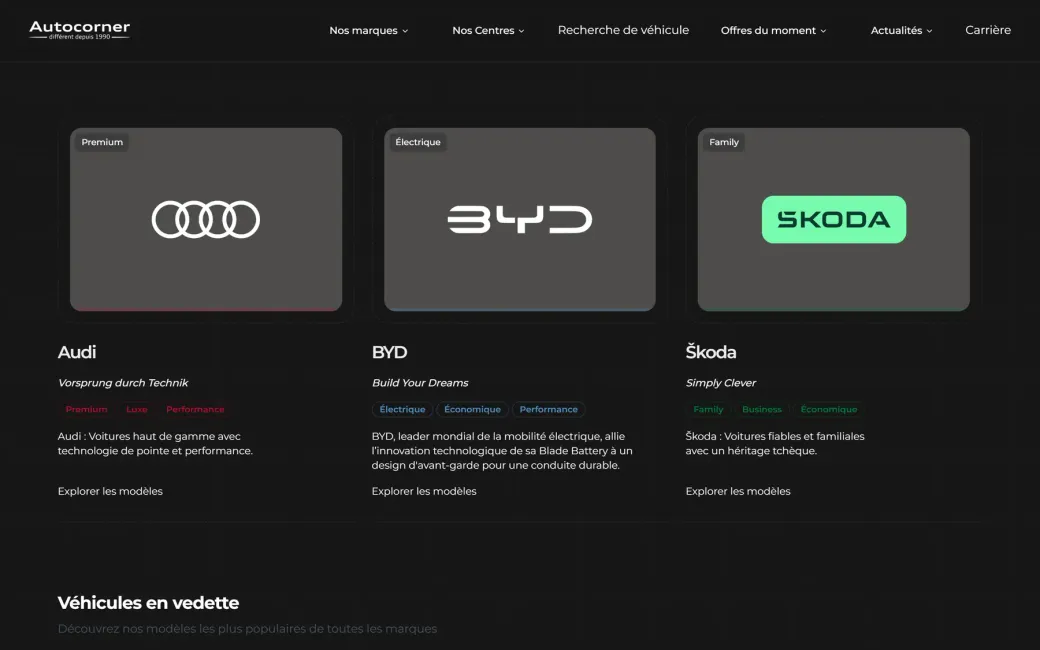
That model proved its value when Autocorner added BYD. The platform already understood brands as first-class entities, so a new identity, centre and fleet could be introduced as configuration and content. What would previously have triggered another website became an extension of the system already in place.
“When BYD joined us, we discovered that we could launch an entirely new centre, fleet and visual identity without rebuilding the platform. The CMS gives us the right balance of freedom and structure.” — Autocorner
Content and live inventory meet on the same page
Editorial content belongs in Sanity: pages, offers, centres, brands, services and campaigns. Vehicle availability belongs in AutoScout24, where Autocorner already manages its stock. Copying one into the other would create a second source of truth, so we connected them instead.
A typed client reads the AutoScout24 API and validates its responses before they reach the interface. The seller identifier on a listing connects the vehicle to the appropriate centre record. That is how one vehicle page can combine a current price, mileage and equipment list with Autocorner’s own opening hours, contact person, brand styling and editorial content.
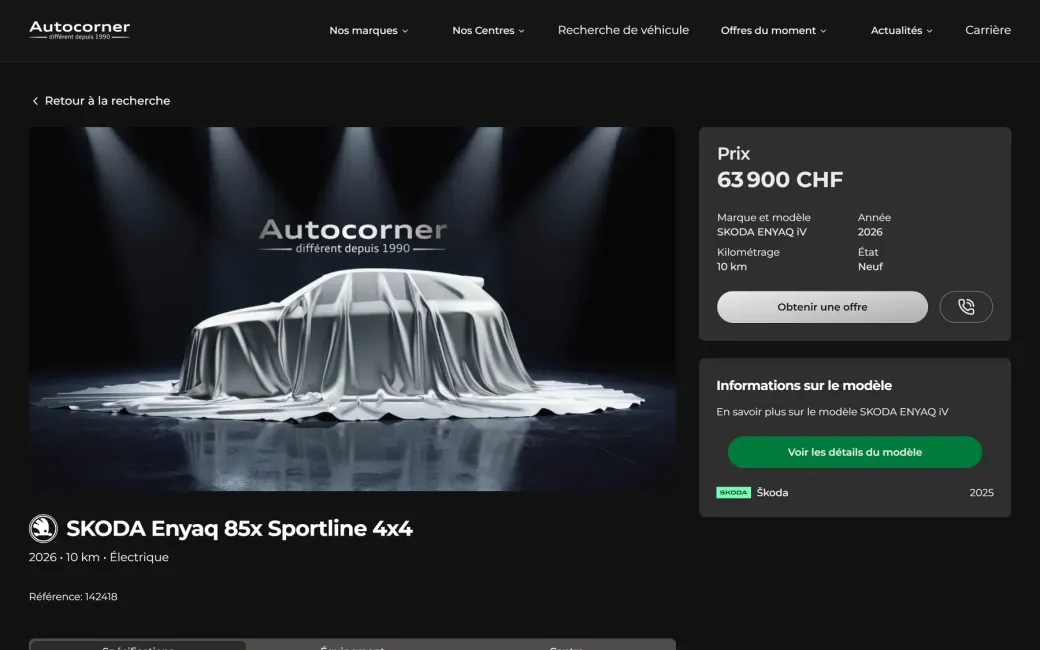
This separation also makes the platform useful beyond the main website. The same vehicle data can feed a campaign or a filtered landing page; the same centre information can appear in navigation, forms and confirmations. Multi-channel does not mean copying content into more places. It means allowing every channel to read from the same dependable foundation.
Search shaped around the customer
Vehicle search is where those choices become visible. Autocorner decides in Sanity which filters appear, in what order, with which defaults and whether they begin open or closed. The entire selection is reflected in the URL, so a search can be bookmarked, shared or reused in a campaign.
The result count comes from the live inventory. A visitor can start from the homepage, choose a make, price and condition, then preview the matching vehicles before opening the full listing. The team can refine that journey without waiting for a new release.
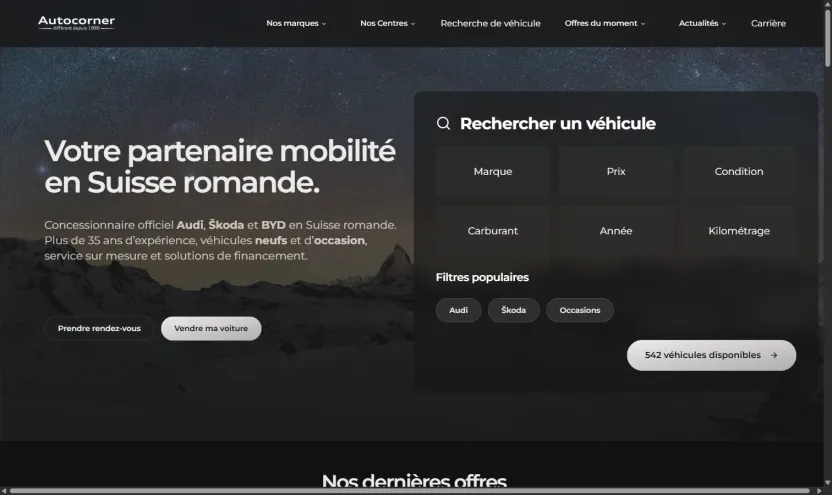
The current inventory count and useful starting points are visible immediately. 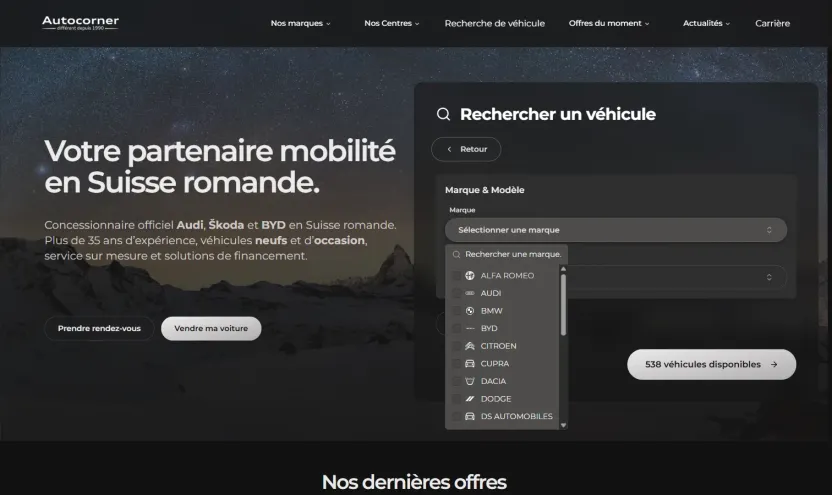
The visitor narrows the stock using a search experience configured by Autocorner. 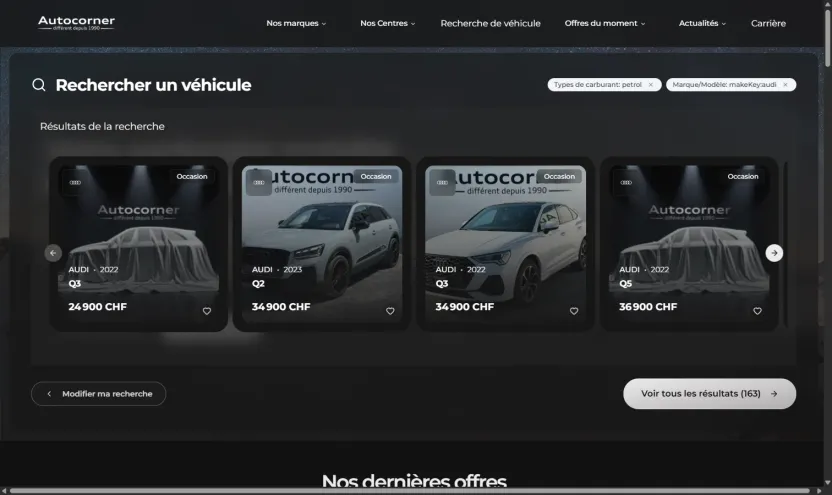
Matching vehicles appear before the visitor leaves the homepage.
A platform that returned more than autonomy
The immediate result was editorial independence: one team can manage pages, brands, centres and campaigns from one place. The architectural result was equally important: one deployment now improves every centre, and the next brand no longer starts from an empty repository.
The commercial result made the value unmistakable. After moving to the platform, Autocorner reported roughly ten times more offer requests, around twenty-five times more used-car buyback requests, and organic traffic beyond what the team had expected from a dealership website.
The lesson was not that every business needs Sanity, Next.js or a custom data layer. Autocorner needed them because its website had to reconcile many brands, many centres, live external inventory and several customer channels without losing consistency. For a smaller organisation whose priority is simply to edit pages with minimal friction, we deliberately choose a lighter solution, as we did for the Cabinet des Alpettes.
For Autocorner, the website became a shared foundation rather than a finished destination. Once content, inventory and customer requests could meet in one place, the next question was no longer how to publish another page, but how the same platform could support the work happening behind it. That is the subject of the next chapter.